Conclusion
No Nonsense: Both Sides of the Plane, and the Dimension Beyond It
June 26, 2026
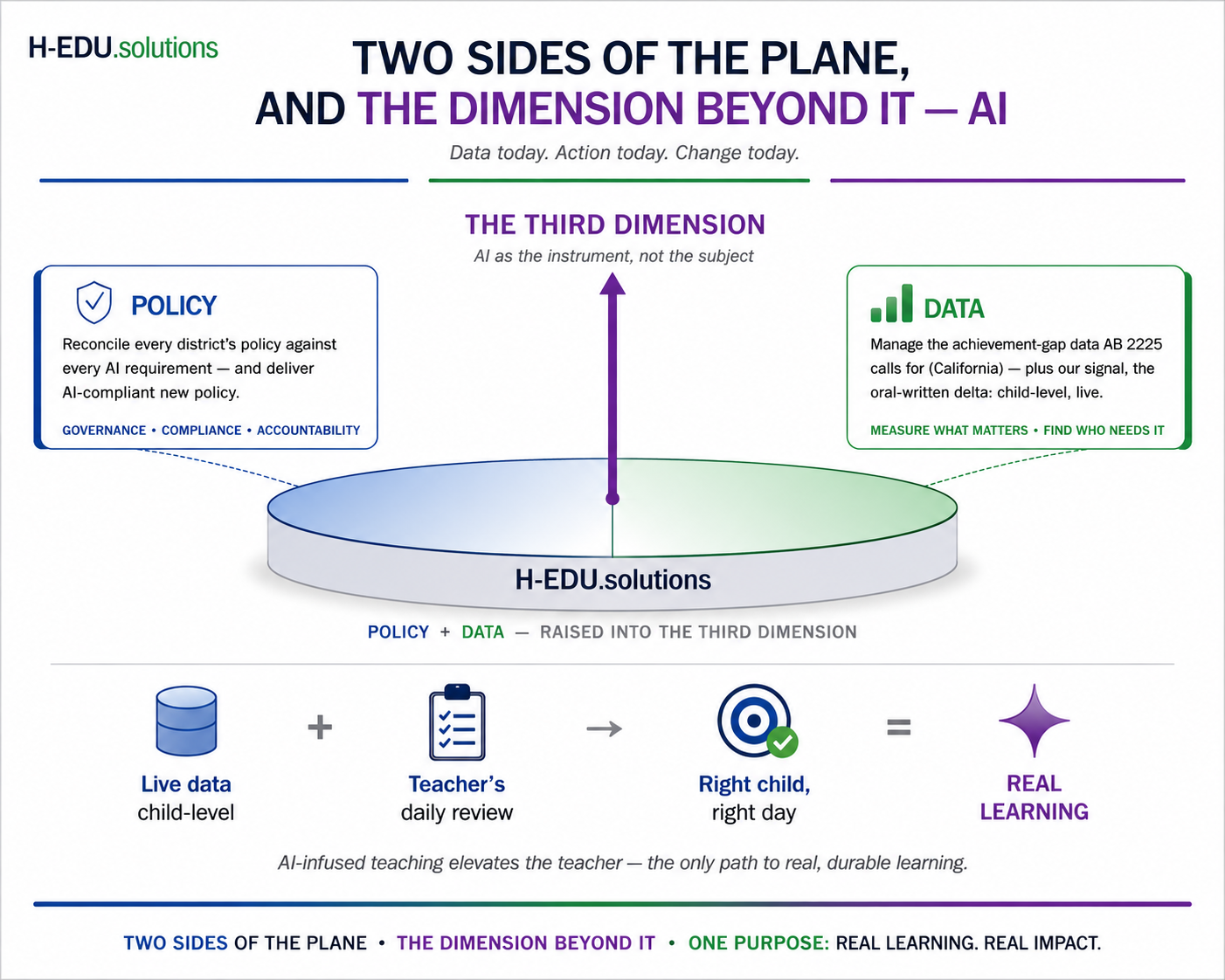
This is no nonsense. Strip away the analogies and the legislative detail, and the whole document reduces to one buildable claim: H-EDU can do both sides of the plane the rest of the field is still drawing — and then add the dimension no one else has built.
On one side, policy. Put every policy of every school district in a state on a table, and put all the requirements of AI on the other side of it — the model policy, the statute, the guidance, the mandates. Reconcile the two, district by district, and deliver back an AI-compliant set of new policies, written to the law and to the moment. That is not a pilot or a promise; it is a reconciliation a disciplined system can perform at scale, and it is exactly the work the governance-compliance incumbents already do — extended, for the first time, to AI. The product side, done right.
On the other side, data. In California, H-EDU can manage the data the AB 2225 process calls for — the measurement substrate behind the achievement-gap plan — and bring to it something that plan does not yet have: our delta, the oral-written gap that finds the specific child the annual test renders invisible. That is the floor. The point is to go beyond it.
Beyond it is the whole purpose. Make the data available — not locked in a research warehouse or flattened into a once-a-year dashboard, but live, at child-level resolution — and supplement it with the one signal no administrative system captures: the teacher’s daily review, the judgment of the human adult in the room. Put those together and you have the instrument panel behind AI-infused teaching — the teacher elevated, not replaced; the intervention aimed at the child who needs it, on the day she needs it. And AI-infused teaching is the only thing that produces the learning — the real, invisible, durable learning — that the work demands and the society advances of tomorrow will require.
Everything in these pages stands behind that claim. The federal government has handed the question to the states. The states are all on the same road, adopting AI plans because preparing children for an AI-shaped world is not optional. The third dimension — AI as the instrument, not the subject — is the only axis that reaches actual learning. Medicine and business already proved that the winners approve the process, not the product, and move before the window closes. Georgia built the policy machine and the data backbone and still never made the instrument. California is deciding, in two live bills, whether to keep perfecting the product or finally build the process. And Georgia State already holds the team and the data to prove the instrument works. Two sides of a plane, and the dimension beyond it. That is the architecture, and H-EDU is built to deliver all three.
None of it waits on permission. The legislation is signed or moving. The data exists. The research team is assembled. The instrument is computable today. The only open question is whether the institutions that hold the seats and the distribution will build the process now, while the ink is still wet — or inherit it later from whoever did. H-EDU’s answer is the one it has always given: don’t lament — engage.