Georgia
The Legislative Tide, and the Machine GSBA Built to Carry It
June 26, 2026
Start with what Georgia’s school boards are actually up against. Georgia has 180 local school districts, and the state legislates education hard and often. In the space of three years the General Assembly has rewritten the rules of reading instruction, pulled phones out of classrooms, stood up the apparatus to govern artificial intelligence, and — in the same 2026 session — rebuilt the governance of its own education data. Every one of those statutes lands as a fresh compliance surface on the same 180 boards.
Reading came first. HB 538 (2023) wrote the science of reading into law: state-approved instructional materials and universal reading screeners three times a year for every K-3 student, dyslexia included. HB 307 (2025) hardened it — banning the ‘three-cueing’ method, dropping Reading Recovery from the approved list, and requiring districts to notify parents within fifteen days when a child is flagged. Then HB 1193, the Georgia Early Literacy Act of 2026, signed by Governor Kemp on May 5, put a literacy coach in nearly every K-3 school — roughly $70 million for some 1,300 coaches — created a statewide Literacy Task Force, and required every district to adopt a unified literacy plan. Three laws in three years, each one a new policy every board must adopt, document, and prove.
Then devices: HB 340 (2025) removed personal electronic devices from K-8, and HB 1009 (2026) extended the ban through grade twelve. Then AI. In January 2025 the Georgia Department of Education issued “Leveraging AI in the K-12 Setting,” drawing the line between high-stakes and ordinary uses — no AI for IEP goals, educator evaluations, or subjective grading; yes for lesson planning, rubric drafting, and multiple-choice grading — and building district self-check steps into the document, a process for districts to stand up their own AI policies. The state named an AI ethics and impact officer that same month and carried a 2024 task-force report urging phased AI policy. This month — June 2026 — the Georgia Department of Audits and Accounts reported that 95 percent of the state’s teachers already use AI to plan instruction, more than half of them weekly. The Superintendent’s posture is the whole stance in a sentence: AI should always be a tool, never a replacement.
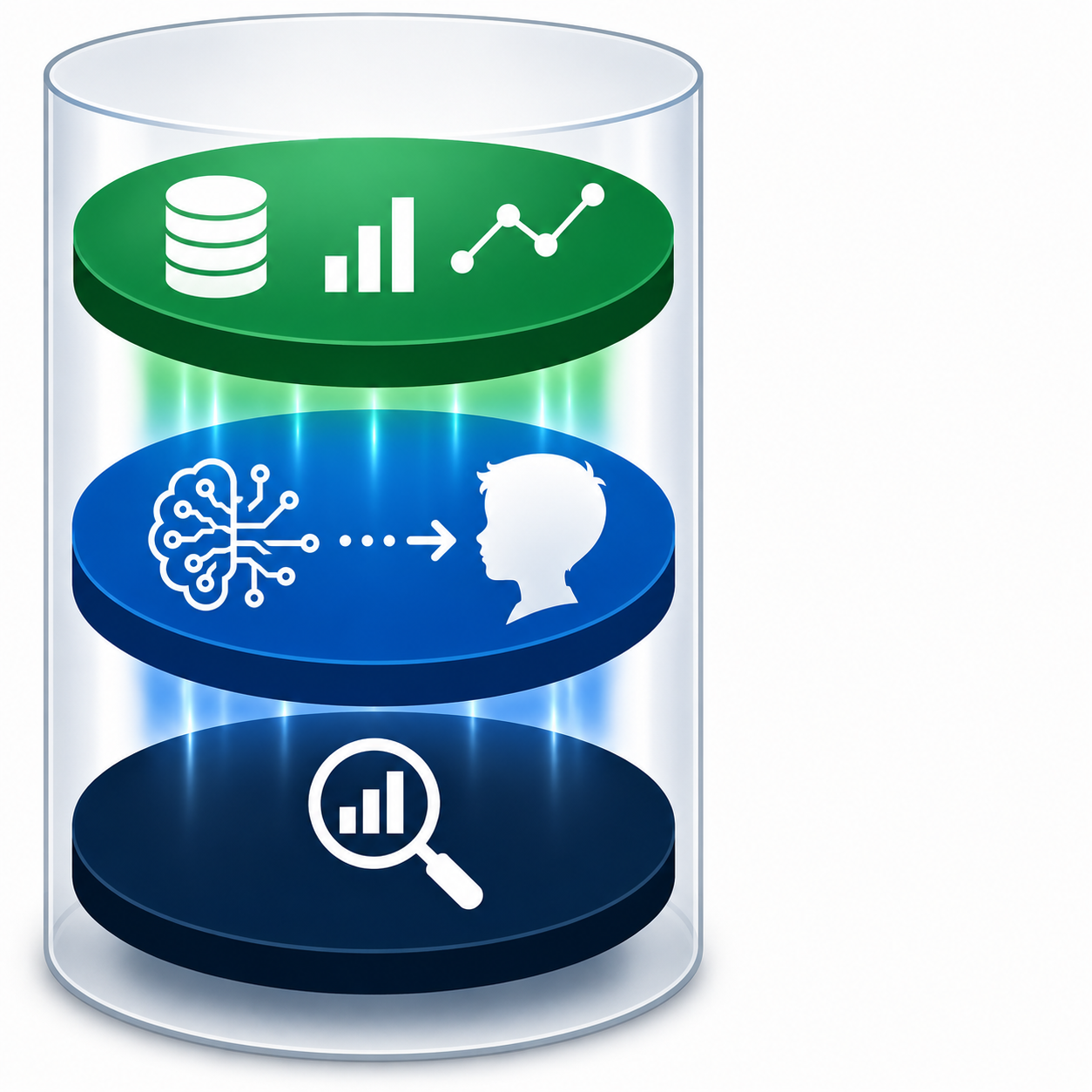
Read that list and notice what it is. Every item on it is the plane from Section 4 — measure it, govern it. Screeners and audits on one axis, policies and self-checks on the other, executed about as diligently as any state in the country executes them. And executed diligently, it is a crushing administrative load. A small district’s board must adopt, version, maintain, and demonstrate compliance with dozens of mandated policies, and the legislature adds more every session. That load — not the politics of it, the sheer clerical weight of it — is the problem the Georgia School Boards Association exists to solve.
GSBA is the membership and advocacy body for those 180 boards. It lobbies the General Assembly on precisely these bills, and then it has to help its members live underneath them. More than twenty-five years ago it began building software to carry that weight, and in 2007 it incorporated the work as eBOARDsolutions, Inc. The product, Simbli, runs six modules — Meetings, Policy, Planning, Evaluations, Communications, Documents — and the load-bearing one is Policy: a single place to adopt, update, search, and prove board policy against the mandates. GSBA built, in other words, the machine for managing exactly the legislative tide just described.
That machine did not stay in Georgia. eBOARDsolutions now serves more than 2,000 organizations across 32 states at roughly a 99 percent renewal rate — 173 of Georgia’s own districts among them. And in California it wears a different name. CSBA’s GAMUT — the policy, agenda, and meeting service California’s districts run on — is Simbli. Follow a California district’s board-policy link and it resolves to simbli.eboardsolutions.com; CSBA’s own mandated-policy chart is served from the same domain. The policy infrastructure of the nation’s largest public-education system is a Georgia product, licensed and rebranded.
This is the intermediary Section 5 named, in the flesh. A single governance-technology incumbent, born of policy-compliance friction, sitting on the policy-compliance chokepoint across 32 states — a business whose entire value is the management of the very transaction costs the Coasean wave is built to compress. eBOARDsolutions is not the villain of this story; it is the best-built expression of the two-dimensional plane there is. It is also, for that exact reason, the layer most exposed the moment the plane stops being mistaken for the work.
And here is the irony worth sitting with. Georgia does not merely measure aggressively — screeners three times a year, dyslexia flags, unified plans, a fresh state audit of AI in its classrooms. It already owns the data backbone the third dimension would run on. GA•AWARDS — Georgia’s Academic and Workforce Analysis and Research Data System — is a Pre-K-through-workforce longitudinal spine that links student- and teacher-level records across more than a dozen state agencies, from early care through K-12 to the technical colleges and the labor department, with a single identifier that follows a child across time. It was seeded by a federal Statewide Longitudinal Data System grant in 2009 and expanded under Race to the Top, Georgia’s $400 million 2010 award, whose plan made completing that spine a pillar — with the explicit aim that teachers would use real-time, student-level data to improve their instruction. Georgia is modernizing it now into a cloud-native platform branded My Georgia Insights. And in May 2026, HB 1302 — the Education and Workforce Strategy Act — renamed the office that runs it from GOSA to GOEWS, dissolved the Alliance of Education Agency Heads that had governed it, and stood up a new cross-agency Education Data Governance Board. The backbone is not only being rebuilt; its governance is being redrawn, this year, in real time.
Fifteen years after that promise, it remains unkept. GA•AWARDS is gated to approved researchers and surfaced to the public only as aggregate dashboards — graduation rates, earnings, discipline. The student-level spine exists; the classroom instrument that would run on it does not. And nothing in it measures the oral-written delta — the child whose spoken comprehension runs grade levels ahead of her written production. So the state that builds the nation’s policy machine, and that already owns a longitudinal data backbone most states would envy, still cannot see the specific mismatch underneath the struggling-reader label. The biopsy is missing not for lack of a laboratory — the laboratory is built, and being rebuilt. The instrument was simply never made. In two dimensions the picture is immaculate. The third is still absent.
Which is the whole problem in miniature, and it points west. The Georgia engine runs California’s policy layer, and California is now deciding — inside a single legislative session — whether to keep perfecting the plane or finally build the substrate. That decision comes down to two bill numbers, and it is the subject of the next section.
Appendix: Acronyms & Terms
AI Artificial Intelligence.
CSBA California School Boards Association.
eBOARDsolutions GSBA subsidiary, incorporated 2007, that develops and licenses the Simbli platform.
GA•AWARDS Georgia’s Academic and Workforce Analysis and Research Data System; the state’s Pre-K-through-workforce (P-20W) longitudinal data system.
GaDOE Georgia Department of Education.
GAMUT CSBA’s board-governance and policy platform for California districts; runs on the Simbli platform.
GOEWS Governor’s Office of Education and Workforce Strategy — GOSA, renamed and expanded under HB 1302 (2026); operates GA•AWARDS.
GOSA Governor’s Office of Student Achievement — the prior name of GOEWS.
GSBA Georgia School Boards Association.
HB 1302 Georgia Education and Workforce Strategy Act of 2026; created GOEWS and a cross-agency Education Data Governance Board.
HB / SB House Bill / Senate Bill.
HQIM High-Quality Instructional Materials.
IEP Individualized Education Program.
K-3 / K-12 Kindergarten through grade 3 / through grade 12.
MSV Meaning-Structure-Visual cueing (‘three-cueing’), the reading method barred by HB 307.
My Georgia Insights GaDOE’s modernized, cloud-native rebuild of the state longitudinal data system (Ed-Fi standard, 2024-25).
oral-written delta The gap between a student’s oral comprehension and her written production — the mismatch Georgia’s screeners and data system do not capture.
P-20W Pre-K through workforce — the span a statewide longitudinal data system covers.
SLDS Statewide Longitudinal Data System (the federal grant program and the systems it funds).
Simbli eBOARDsolutions’ six-module board-management software: Meetings, Policy, Planning, Evaluations, Communications, Documents.
Sources
Georgia School Boards Association and eBOARDsolutions — “Our Story” and Simbli product pages (gsba.com; eboardsolutions.com).
CSBA — GAMUT and Policy Services pages (csba.org); California district policy portals hosted at simbli.eboardsolutions.com (e.g., Pioneer Union ESD; Eureka City Schools).
Office of Governor Brian P. Kemp — “Gov. Kemp Signs Bills Strengthening Literacy and K-12 Schools,” May 5, 2026 (HB 1193; HB 1009); “Gov. Kemp Signs Legislation Strengthening Georgia’s Workforce,” May 11, 2026 (HB 1302).
Georgia General Assembly / LegiScan — HB 538 (2023), HB 307 (2025), HB 1193 (2026), HB 1302 (2026).
Georgia Department of Education — “Leveraging AI in the K-12 Setting,” January 2025; appointment of an AI ethics and impact officer, January 2025.
Georgia Department of Audits and Accounts — audit of AI use in Georgia classrooms, June 2026 (reported via Georgia Public Broadcasting / Georgia Recorder).
Governor’s Office of Student Achievement — GA•AWARDS / Statewide Longitudinal Data System pages (gosa.georgia.gov).
Institute of Education Sciences / NCES — Georgia SLDS profile, the 2009 SLDS grant, Race to the Top (2010), and the “My Georgia Insights” modernization.
Education Commission of the States — overview of state AI-in-education task forces and legislation (Georgia 2024 task-force report).