The Third Dimension
Beyond Data and Policy: AI as the Instrument, Not the Subject
June 26, 2026
In Section 3 you watched the third dimension at work. Maya’s day was not a story about a better app or a stricter rule. It was a classroom operating in a dimension the current debate has no word for — and that missing word is the reason the debate keeps circling the same two points.
The national conversation about AI in education runs on two axes, and only two. The first is data — measurement, analytics, dashboards, and the privacy rules that surround them. The second is policy and procedure — governance frameworks, acceptable-use rules, model policies, oversight. Walk into any convening in 2026 and that is the entire floor plan: measure it, and govern it. Both axes are necessary. Neither one is the work.
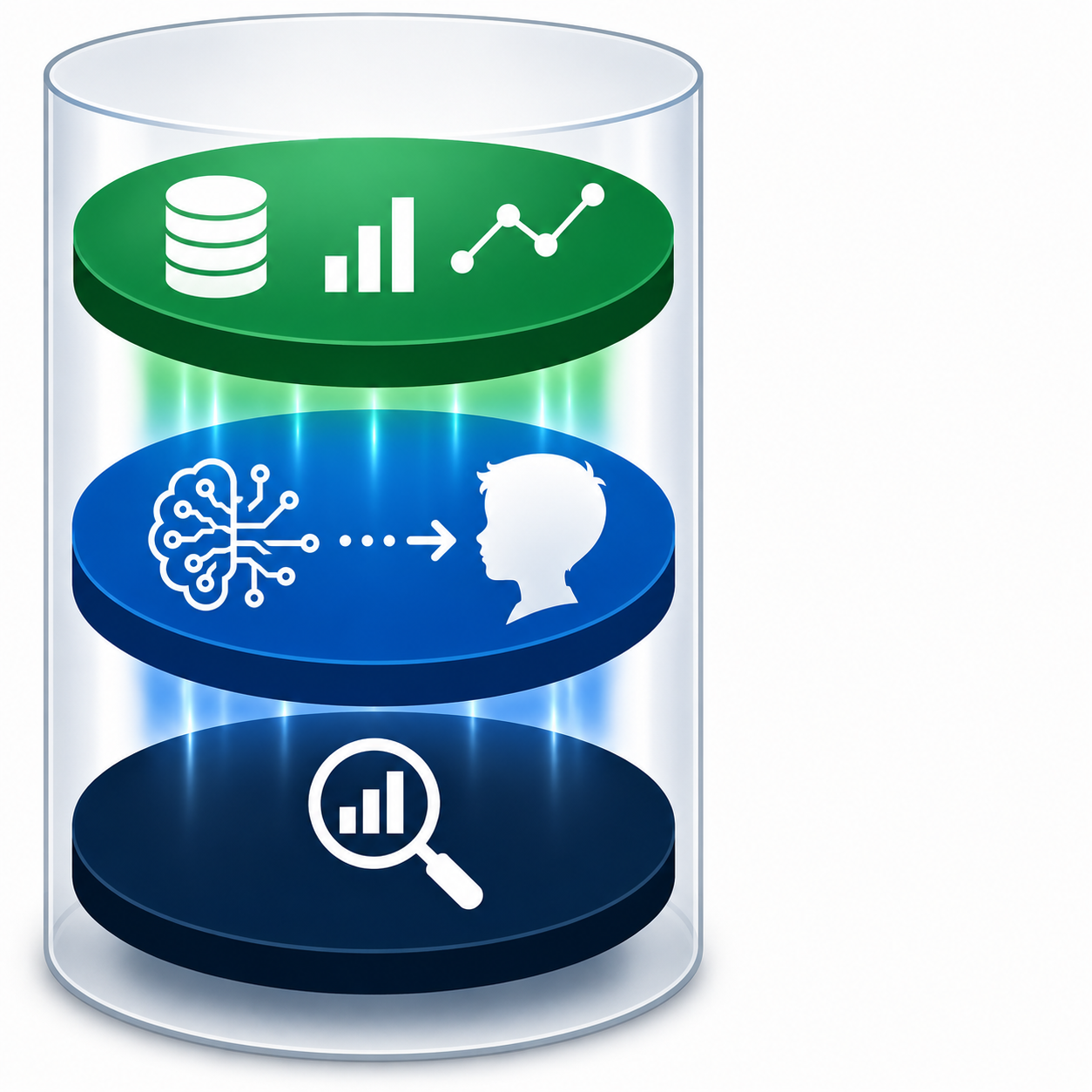
Look at what each axis can actually reach. Data analysis measures the visible — the score, the dashboard, the picture. Policy and procedure governs the visible — who may use which tool, with what disclosure, under what audit. These are the two dimensions of a plane, and a plane has no depth. You can perfect the measurement and perfect the governance and still not have moved a single child, because the plane never touches the thing that actually prepares her.
The third dimension is AI as the instrument, not AI as the subject. Not the thing being measured. Not the thing being governed. The thing doing the work — the platform that delivers the right intervention to the right child at the right moment, the daily loop that turns this morning’s signal into this afternoon’s lesson, the measure that surfaces the child a once-a-year test renders invisible. Teaching is visible; learning is invisible. The first two dimensions can only ever inspect what is visible. The third dimension is the only one that reaches the invisible — the actual learning, and the readiness to think and work in a world that will be saturated with these tools.
The instinct of every system is to finish the plane first — complete the data architecture, finalize the model policy — and add the depth later. That instinct guarantees the depth is never built. Policy does not finish: SB 1288’s model policy will be revised, and revised again. Data integration does not finish: there is always one more system to connect. If the rule is finish the floor, then build, the building never starts. And the technology is not waiting on the policy calendar — it is moving on the 2028 clock you just saw in Maya’s classroom.
So the plane and the volume are not sequential phases. They are raised together. You add the third axis now, while the policy ink is still wet, because that is the only window in which the third dimension gets designed on purpose — by educators, for children — rather than arriving pre-built from whoever moved first. Wait for two dimensions to be complete and you will inherit the third from someone who did not.
This is the through-line of everything in these pages. The federal retreat hands the question to the states. The states’ policy road builds the floor. Maya’s day is that floor with depth added. What remains is to show where the depth gets built first — and why California and Georgia are where the third dimension is ready to stand up.