My Child
October 20, 2028
Vision without a concrete picture is just rhetoric. So let me describe a single day in the life of one child in the 2028 classroom, in enough detail that the design decisions are visible.
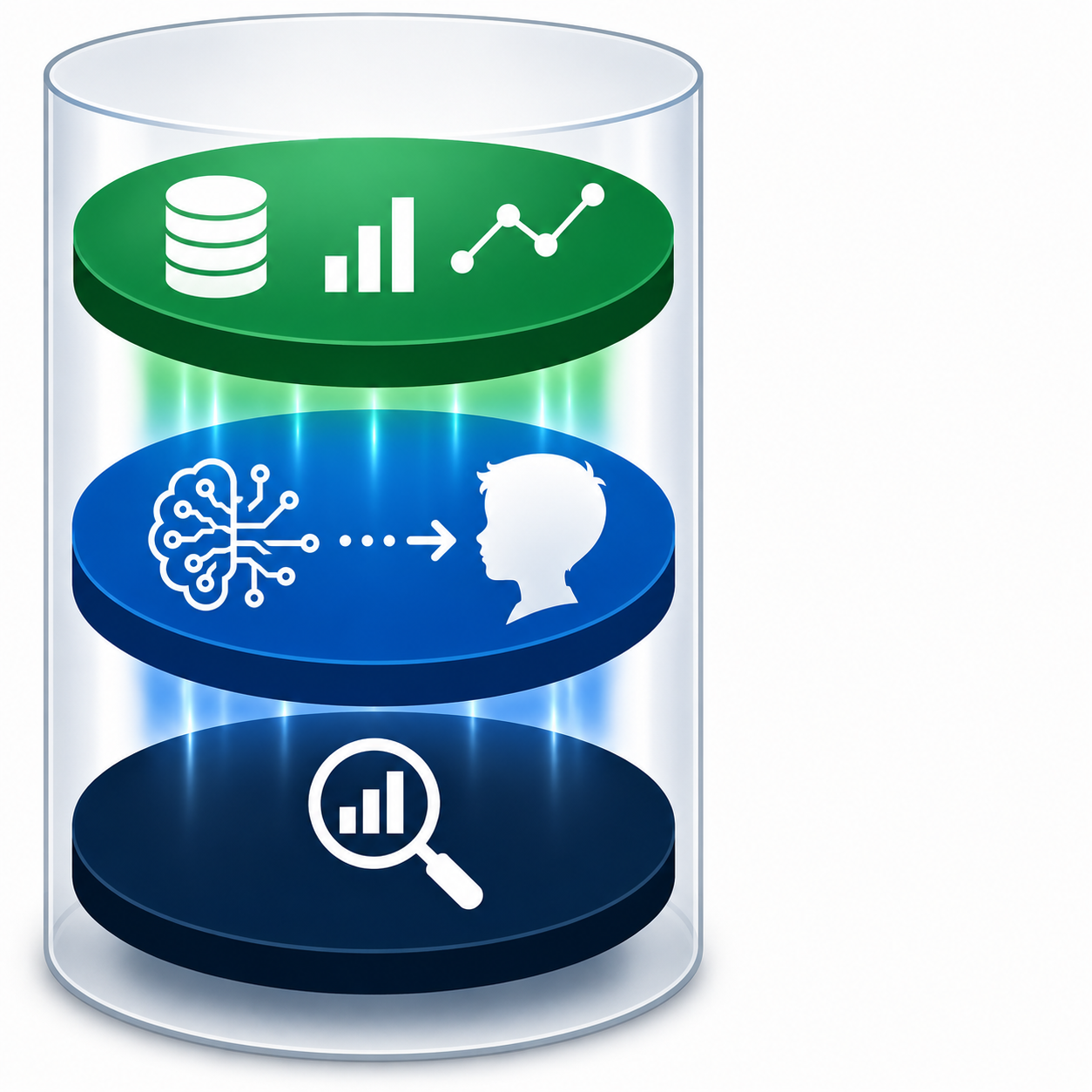
Maya is nine years old, in third grade, at an elementary school somewhere in California on October 20, 2028. She arrives at 7:52 AM. As she comes through the front gate, the school’s sensing infrastructure — cameras above entrances, Wi-Fi location logging on her school tablet — registers her arrival as an anonymized identifier. The system is not secret. Her parents received plain-language disclosure when she enrolled. They have a parent portal where they can see their own child’s data.
They have meaningful opt-out options. They chose in. The governance principles are explicit: data is aggregated before it is useful, individual records are accessible only to named staff with specific operational need, vendors do not own the data or use it to train commercial models, the district is custodian and the district is accountable. These principles are not negotiable. They are the reason the system is defensible.
Maya walks toward her classroom. The system notices she is walking alone, as she has walked alone for the past eleven school days — a pattern change from the previous months when she walked with a cluster of three other girls. The pattern-detection system does not alert the principal dramatically. It surfaces on the morning dashboard of her teacher, Ms. Rivera, a short list of children whose social-contact patterns have shifted in the past two weeks. Maya is on that list. Ms. Rivera sees her name and understands what the shift means, because Ms. Rivera is the human in the loop — the adult whose job is to notice what the system surfaces and to decide what to do about it.
At 8:05, at the start of the morning’s reading block, Ms. Rivera sits down next to Maya and asks her what she is reading. She listens. She follows up on something Maya mentioned last week about her grandmother’s garden. Five minutes of attention, directed by the data toward the child who most needed it, produced without any intrusive adult gaze, uncovered only because the measurement infrastructure revealed the pattern and the human adult acted on it. This is the memorable-teacher function operating with tooling it has never had before.
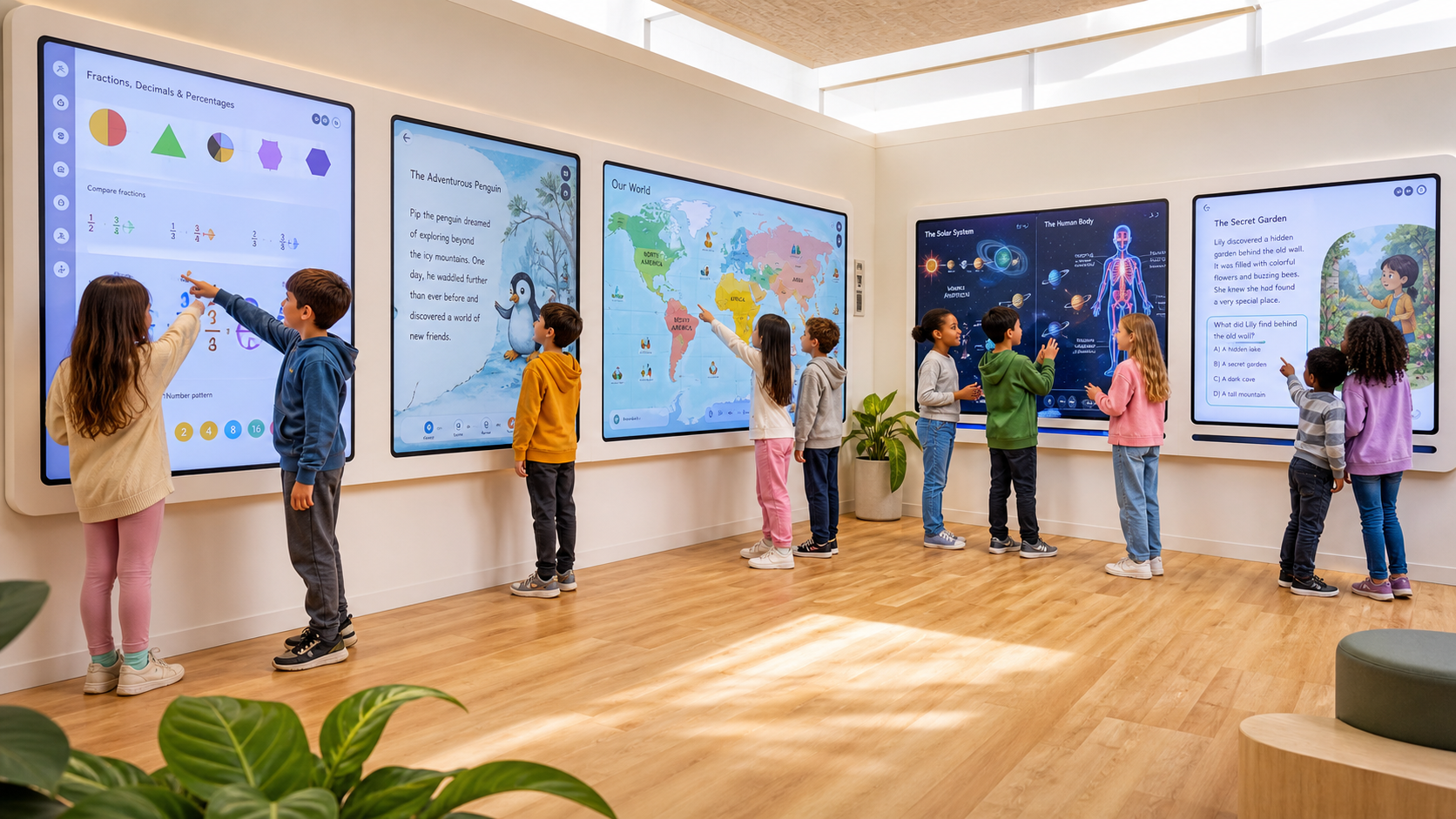
At 8:30, the morning’s panels rearrange themselves around the perimeter of the classroom. Ms. Rivera is seated at her desk, looking at her pixel-cluster display.
Each of her 28 children is represented as a cluster whose color and pattern indicate their current state: engaged, struggling, distracted, in flow. The boards around the room are configured for the morning’s range of learning tasks — one panel running a phonics scaffold at Maya’s exact reading level, another running a writing workshop for the six children ready for it, another running math through stories, another open for free reading with AI reading-companions. Children can remain in their seats working on individual devices, or they can walk over to the panel that interests them most. Some walk. Some stay. Some cluster at panels. Some work alone. The classroom is a coordinated heterogeneous environment, not a synchronized homogeneous one.
Maya walks to the reading panel. She finds herself standing next to Mateo, whom she has not spoken to in six weeks. They read together at the panel’s prompting. The platform observes that Maya’s reading pace has improved since last Tuesday and adjusts the difficulty slightly. Ms. Rivera, watching from her desk, sees Maya’s pixel cluster shift into the engaged-and-progressing state and registers, without making a fuss, that her 8:05 intervention worked.
At 11:45, the children go to lunch. The sensing system logs arrivals in the cafeteria. Maya pauses for a moment — a moment Ms. Rivera would never have seen — scanning the tables. She sees Mateo at a table with two other children. She walks over and sits down. The pattern-detection system notes that Maya has joined a table for the first time in 12 school days.
While the children eat and then go to recess, Ms. Rivera sits down with her own lunch at 11:50. Her display is in front of her. The platform has prepared her lunchtime briefing. For each of her 28 children, it summarizes the morning: what the system flagged, what the system observed, what her decisions produced.
Diego’s entry shows a morning math assignment that went badly, with the platform hypothesizing a misunderstanding of a prior concept rather than the current one and recommending reassignment. Aisha’s entry flags an anomaly — high engagement but unusually thin written output — without interpretation, leaving the judgment to Ms. Rivera.
By 12:25, Ms. Rivera has reviewed the briefing, affirmed some recommendations, overridden others based on her knowledge of specific children, and the afternoon’s configuration has been adjusted to what the morning revealed. This is the same-day feedback loop no industrial-era teacher has ever had, and it is the mechanism that makes designer education actually responsive rather than theoretical.
At 12:30, the children return from recess. Ms. Rivera calls them in and asks them to stand beside their seats. ‘Simon says hands on your head.’ Hands go up. ‘Simon says hands on your shoulders.’ Hands move. ‘Touch your knees.’ Two children bend; the rest catch the trap. The room laughs.
‘Simon says hop on one foot.’ The room hops. Ms. Rivera is reading the room even as she plays. She sees Diego laughing, which is a good sign after his difficult morning. She sees Aisha participating fully. She sees Maya laughing next to Mateo. The three-minute game ends. The children sit. The afternoon panels begin to configure themselves.
Nothing in this scene requires magical technology. Every element is achievable on capabilities already in production use by 2026. The classroom is still a room. The teacher is still the human who matters. The building is still load-bearing infrastructure for working families. The socialization is still happening. The civic function is still being served. The budget is flat because Ms. Rivera is not spending her morning delivering phonics instruction to 28 children simultaneously; the platform is delivering differentiated phonics at each child’s level, and Ms. Rivera is doing the uniquely human work her training and experience now prepare her for.
The teacher in this vision is not replaced. The teacher is elevated. Her physical demand is reduced — she is not standing for six hours. Her cognitive demand is concentrated on judgment and attention rather than undifferentiated volume. Her feedback loop is visible — she sees her interventions work. Her grading burden is gone — the platform grades routine work in seconds and surfaces for her judgment only the work that requires it. Her evenings and weekends belong to her family. The profession that the industrial-era classroom ground down to exhaustion by year seven becomes, in 2028, a profession a thoughtful person can do for a lifetime without burning out. The compensation and credentialing structures must follow this redefinition. A teacher whose work is orchestration, judgment, and relationship is doing harder and more consequential work than a content-delivery teacher. These reforms follow from the architectural shift; they do not precede it.